When you were a child, time felt wide.
A single summer seemed endless.
Waiting for a birthday felt like torture.
Even one school hour could stretch forever.
Now something strange happens.
Weeks disappear without warning.
Months blur together.
Years feel like they’re quietly slipping through your hands.
You look at the calendar and feel confused.
The clock hasn’t changed.
The length of a second hasn’t changed.
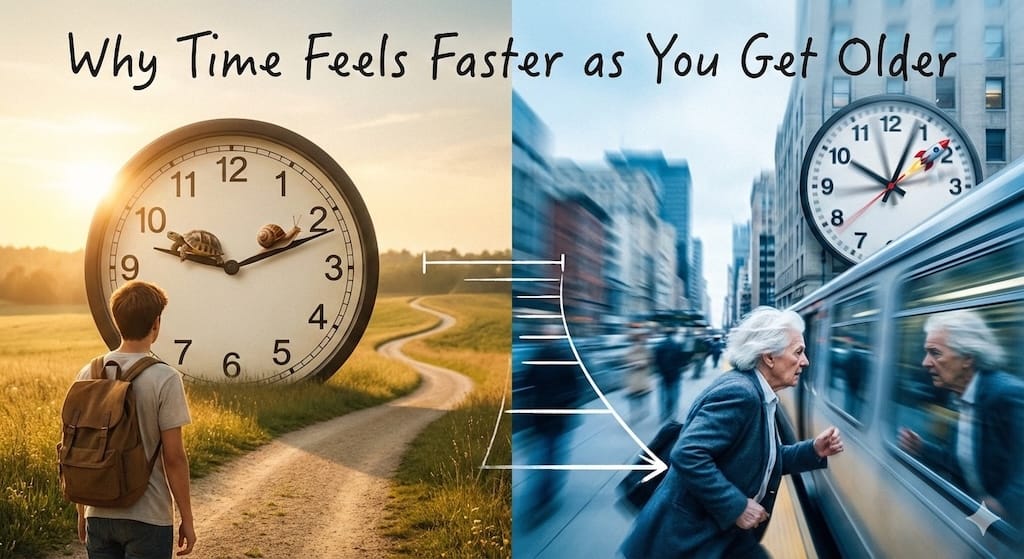
So why does time feel faster as you get older?
The answer is not emotional.
It is not imaginary.
And it is not nostalgia.
It’s a real interaction between physics, the brain, and memory.
🧠 Time Is Constant — But Your Experience Is Not
In physics, time is treated as a steady dimension. One second today is the same as one second a thousand years ago. Atomic clocks confirm this with extreme precision.
But your brain does not experience time directly.
Your brain does something else.
It reconstructs time after it happens.
What you feel as “time passing” is actually your brain measuring:
- Change
- Novelty
- Attention
- Memory density
When those things change, time feels different.
Physics stays constant.
Perception bends.
👶 Why Time Felt Slower in Childhood
Childhood is a storm of new experiences.
Everything is unfamiliar:
- First school
- First friends
- First fears
- First discoveries
- First mistakes
Your brain is forced to process enormous amounts of new information every day. This creates dense memory formation.
More memories = more perceived time.
There’s also a simple mathematical reason.
When you are 5 years old, one year is 20% of your entire life.
When you are 40, one year is 2.5% of your life.
Each year literally becomes a smaller fraction of your existence.
Time doesn’t speed up.
Your reference frame expands.
🧍♂️ Why Adulthood Makes Time Collapse
As you grow older, something changes.
Life becomes predictable.
- Same routes
- Same schedules
- Same environments
- Same routines
The brain is efficient. Once it recognizes patterns, it stops recording details.
This efficiency is useful for survival, but it has a side effect.
When fewer new memories are formed, your brain has less material to measure time with.
Looking back, entire months feel empty. Not because nothing happened, but because nothing stood out.
Time feels fast in hindsight, not in the moment.
⚛️ Physics Has a Perfect Analogy
In physics, motion works the same way.
If an object moves at a constant speed in a straight line, it feels stationary relative to itself. Motion only becomes noticeable when velocity changes.
Acceleration reveals motion.
Your life works exactly the same way.
- High change = slow-feeling time
- Low change = fast-feeling time
When life accelerates with new experiences, time stretches.
When life moves at constant velocity, time disappears.
🧪 Experiments That Prove Time Is Elastic
Scientific studies consistently show:
- New environments slow perceived time
- Fear and danger stretch moments
- Boredom makes time feel slow while happening but short in memory
- Routine days feel fast in the moment and empty afterward
This explains a strange paradox.
A vacation:
- Feels long while you’re living it
- Feels short when you remember it
A routine month:
- Feels short while passing
- Feels almost nonexistent in memory
Time perception has two versions:
- Experienced time
- Remembered time
Your brain judges life mostly by the second one.
🌌 Is Time Actually Speeding Up?
No.
Physics confirms time flows at a stable rate on Earth.
However, physics also reveals something fascinating.
Time can slow down due to:
- Speed (near light speed)
- Gravity (near massive objects)
This effect is real and measurable. Satellites orbiting Earth experience time slightly differently than people on the ground. GPS systems must correct for this difference to work accurately.
But this has nothing to do with aging.
Your feeling of time accelerating is psychological, not cosmic.
🧠 Why the Brain Speeds Time Up on Purpose
Your brain is not broken.
It is optimized.
As you age, the brain:
- Automates decisions
- Reduces energy usage
- Compresses repetitive information
This keeps you efficient but reduces the richness of memory.
From a survival perspective, this is smart.
From a time perception perspective, it’s devastating.
Efficiency trades depth for speed.
⏱️ Can You Slow Time Without Breaking Physics?
You cannot change the speed of time.
But you can change how it feels.
Physics gives a clear solution: increase change.
You slow perceived time by:
- Learning new skills
- Changing routines
- Visiting unfamiliar places
- Paying focused attention
- Breaking patterns intentionally
Novelty creates memory anchors.
Memory anchors stretch perceived time.
You don’t need more hours.
You need more distinct moments.
🔍 A Powerful Thought Experiment
Imagine two people live one year.
Person A:
- Same routine every day
- Same route
- Same environment
Person B:
- Learns a new skill
- Travels occasionally
- Changes habits
Both lived the same amount of time.
But only one remembers living it.
Time feels long when it leaves traces.
🌒 The Quiet Truth About Time
Time is not slipping away faster.
Your brain is simply recording less contrast between moments.
Physics keeps time steady.
Memory decides how full it feels.
And once you understand that, time stops feeling like an enemy and starts feeling like a design choice.