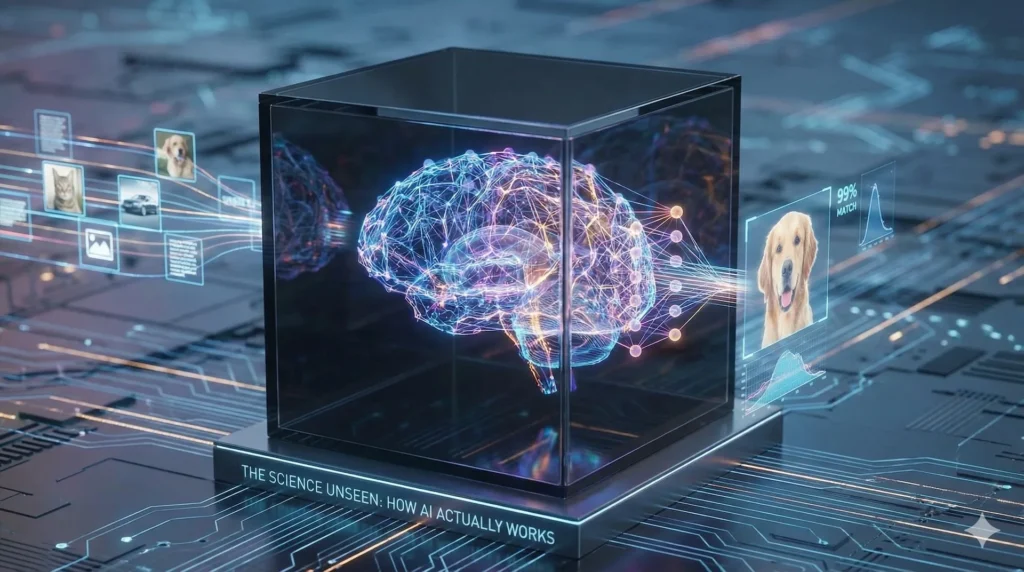
Artificial Intelligence feels so much mysterious because it behaves in ways so that our brains associate it with intelligence.
It can answer questions.
It can write text.
It can easily recognize faces.
It can create images.
But still AI is not thinking.
It is also not reasoning, understanding, or being creative in any of human sense.
And once you understand what is actually happening inside AI systems then this mystery disappears completely or may not be.
In this article we will explains how artificial intelligence actually works step by step and in plain language without buzzwords or without exaggeration and without any misleading comparisons.
Artificial intelligence starts by destroying meaning
First and most important truth about AI which is uncomfortable for many people is:
AI never sees meaning of anything.
Before AI can do anything useful for us it first converts everything into numbers.
Text becomes just numerical tokens
Images are pixel values
Audio are also just wave measurements
Video becomes just sequences of frames
At this stage:
- Words are not words
- Images are not objects
- Sounds are not voices
They are just numbers.
When AI process a sentence then it does not see any language.
It is only seeing patterns of numbers which are often appear together.
This single fact can explain nearly every strength and weakness of AI.
AI does not learn like humans learn
Humans learn by understanding things.
We grasp ideas and then form mental models in our neurons in our brain and then connect meaning by experience in daily life.
AI is not doing anything of it.
AI learning only through examples and correction.
If you want an AI system for identifying cats then you do not have to explain:
- what a cat is
- what fur means
- why whiskers matter
Instead you need to show it:
- millions of images which are labeled as “cat”
- millions of images which are labeled as “not cat”
Then system will slowly adjusts itself until it can be able separate these two groups with high accuracy.
At any point it do not know what a cat is.
It only have learned what cat like data will look statistically.
Training an AI is structured trial and error
AI learning is often described as “training” which is sounds intelligent and intentional.
But in reality training is just guided guessing.
During training:
- AI make a prediction
- This prediction is compared with correct answer
- Then difference is measured as error
- Now internal values are adjusted for reducing this error
This process will be repeated again and again.
For millions of guesses
With millions of corrections
And tiny improvements each time
Nothing is understood by AI.
There is nothing which is remembered as experience.
These systems just simply become better at not being wrong.
Neural networks are mathematical pipelines, not minds
Most modern AI systems rely on neural networks.
This name suggests biology but this similarity is mostly superficial and there is nothing to do with biology.
A neural network is:
- a chain of mathematical operations
- then organized into layers
- where each layer is slightly transforms into numbers
Early layers are for detecting simple patterns
Later these layers detect combinations of these patterns
For example:
- edges → shapes → objects
- letters → words → sentence patterns
No layer have understanding of what it have detects.
Each layer is only passing transformed numbers forward.
Appearance of intelligence comes from scale and depth and by not awareness in AI models.
Why AI needs enormous amounts of data
Humans can learn any concepts just by very few examples.
Like when child see a chair and understand idea of “chair.”
But AI cannot.
AI must have to see:
- thousands of chairs
- by different angles
- at different lighting
- with different designs
Why?
Because AI don’t know what actually matter.
Humans automatically focus on meaning whatever they see or observe.
AI need to discover importance by repetition.
If any feature is appearing frequently in many correct examples then AI will assumes that it is important.
This is why:
- biased data creates biased AI
- incomplete data creates unreliable AI
AI only reflects on patterns which are shown to it.
AI does not follow rules like normal programs
Traditional softwares are rule based.
“If this condition is met then do this action.” Like if-else statement if you know coding.
But AI don’t work in that way.
AI works on probability.
System estimates for every possible output:
- how likely is this output is
- based on everything has it seen anything before
It then chooses most probable option.
This makes AI:
- flexible
- adaptable
- powerful in uncertain environments
But it also means that AI is always guessing.
Even when it sounds like sure.
Language models only predict text they do not know facts
When AI generates text it is not only retrieving information from database.
But it is predicting about what word should come next.
Based on training data these model estimates:
- which words are mostly likely to follow this previous ones
Then it repeats this process word by word.
This is main reason why AI can:
- write beautifully
- explain concepts so much clearly
- sounds too confident
And also why it can:
- invent sources
- can mix facts incorrectly
- sometimes can explain things which do not exist
These systems have no concept of truth.
Only probability.
Why AI sounds confident even when it is wrong
Confidence is an illusion which is created by language fluency.
AI can produces:
- structured sentences
- logical flow
- authoritative tone
But AI does not know anything like:
- if something is true or not
- if a source is real or not
- if an answer makes sense or not
If a response looks statistically correct for AI model then it will produce it.
This behavior is called “hallucination” but it is not imagination.
It is a unverified prediction.
What actually happens when you ask AI a question
From inside this is what occurs:
Your input is converted into numbers
These numbers are pass through many layers of calculations
And each layer adjusts probabilities slightly
Then system selects most likely next word
And that word becomes part of next prediction
This continues until response is ended.
AI can never pause us for thinking.
And it never checks its answer.
It is only predicting.
Why AI feels intelligent then humans
Humans trust communication.
When something:
- uses language fluently
- responds instantly
- explains everything clearly
Our brain associate this with intelligence.
AI is unintentionally exploiting this bias.
It does not understand any language but it imitates its structure so perfectly.
This creates a powerful illusion of thinking.
Where artificial intelligence is genuinely powerful
AI is extremely good at tasks which involve:
- large amounts of data
- pattern recognition
- repetition
- speed
Examples are:
- image recognition
- recommendation systems
- fraud detection
- language translation
- search optimization
These tasks require accuracy not understanding.
Where artificial intelligence fundamentally fails
AI is struggling so much with:
- common sense reasoning
- understanding cause and effect
- transferring knowledge between contexts
- knowing when it is wrong
It cannot:
- experience world
- form intentions
- understanding consequences
AI has no internal model of reality.
It only have patterns.
Biggest misunderstanding about AI
The most dangerous myth is that AI is “almost human.”
But it is not.
AI can not:
- think
- feel
- want
- understand
It even don’t know that it exists.
The power of AI is comming from scale not by intelligence.
Why understanding AI correctly matters
When people believes that AI can understands:
- they are trusting it too much
- they have stopped verifying information
- they treat output as authority
This is how misinformation can spreads very quickly.
Correct way of using AI is as:
- a powerful assistant
- a pattern amplifier
- a tool that requires human judgment
Not as a source of truth.
Real truth about artificial intelligence
Artificial Intelligence is not magic.
It is just mathematics, data, and probability which is executed at enormous scale.
It works not because it understands world
but because this world contains patterns and AI is very good at finding patters.
Real risk is not that AI is becoming conscious.
But real risk is humans are confusing prediction with understanding.
Once you see AI clearly
you stop fearing it and then start using it wisely.
📚 Research & Reference Links
Core Understanding
- Stanford AI Index Report
https://aiindex.stanford.edu - MIT OpenCourseWare – Machine Learning
https://ocw.mit.edu
Neural Networks Explained
- 3Blue1Brown – Neural Networks
https://www.3blue1brown.com/topics/neural-networks - DeepLearning.ai
https://www.deeplearning.ai
Language Models & Prediction
- “Attention Is All You Need” (Transformer paper)
https://arxiv.org/abs/1706.03762 - Hugging Face Learning Hub
https://huggingface.co/learn
AI Limitations
- OpenAI Research
https://openai.com/research - IBM Research – Explainable AI
https://research.ibm.com