☀️ The Sun — Our Life Source
The Sun is the heart of our solar system. It provides light, warmth, and energy that makes life on Earth possible. But what if, in an instant, the Sun completely disappeared?
Let’s explore what would happen — second by second, day by day.
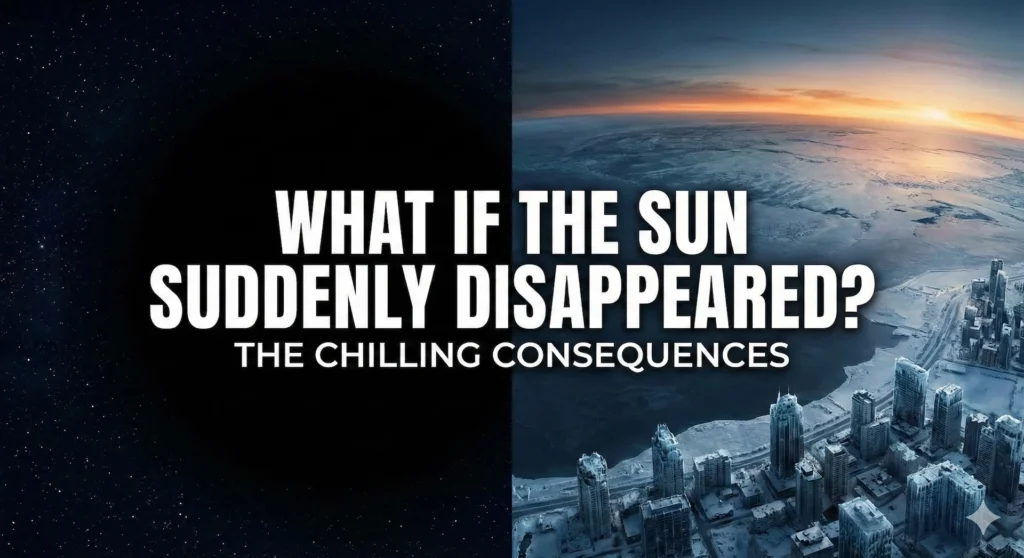
⏱️ After 8 Minutes — Darkness Falls
It takes 8 minutes and 20 seconds for sunlight to reach Earth. So, if the Sun vanished, we wouldn’t know right away.
For 8 minutes, everything would look normal… and then, suddenly, complete darkness.
The skies would go black — no sunrise, no sunsets, just an endless night. The Moon and planets would vanish too, since they only reflect sunlight.
🌍 After a Few Hours — The Cold Begins
Without sunlight, the Earth’s surface would start cooling quickly.
- Within 24 hours, temperatures would drop below freezing.
- Within a week, the average temperature would reach −73°C (−100°F).
Oceans would start to freeze from the top, forming thick ice sheets.
💨 The Atmosphere Collapses
Plants would die within days because of the lack of photosynthesis.
Soon, oxygen levels would drop, and carbon dioxide would rise. The atmosphere would thin out, and winds would stop blowing — because there’s no sunlight to drive them.
🌑 Gravity Chaos
You might think Earth would stay in its orbit — but the Sun’s gravity is what holds all planets in place.
Without it, Earth would shoot off in a straight line, traveling through the darkness of space forever.
Every planet, asteroid, and comet would drift away too — our entire solar system would disintegrate.
❄️ After a Year — A Frozen World
After one year, Earth’s surface would be around −240°C (−400°F) — almost as cold as Pluto.
The atmosphere would freeze and fall as snow made of oxygen and nitrogen.
Only creatures deep in the ocean, near volcanic vents, might survive.
💭 Final Thoughts
If the Sun disappeared, life on Earth would end within days — but the planet itself would continue drifting through the dark universe.
It’s a chilling reminder of how fragile our existence is — and how much we depend on our nearest star.