Everyone understands aging on the surface.
Skin wrinkles. Hair turns gray. Energy fades. Healing slows.
But biology asks a deeper question:
Why does life age at all?
From an evolutionary perspective, aging seems inefficient. If living organisms are designed to survive, why would nature allow bodies to slowly break down instead of maintaining themselves forever?
The answer lies not in years or birthdays, but deep inside cells, DNA, and microscopic processes that have been running since life first appeared on Earth.
Aging is not one thing.
It is a quiet accumulation of many tiny biological compromises.
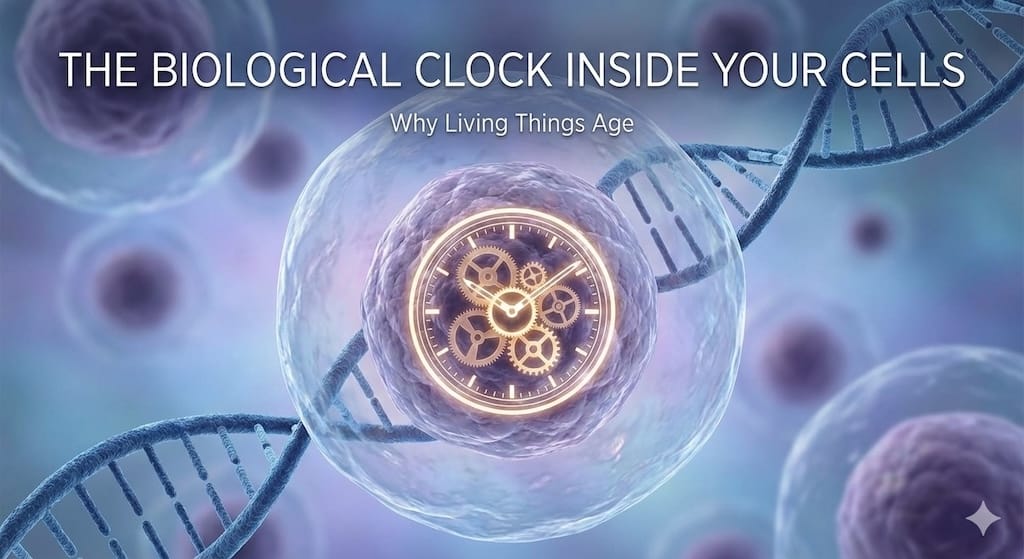
🧬 Cells: The First Place Aging Begins
Your body is made of trillions of cells, and every one of them has a lifespan.
Cells are not immortal. They are born, they work, and they eventually stop dividing or die. This limit exists to protect the body, but it also creates aging as a side effect.
Every time a cell divides, it must copy its DNA. While this copying is incredibly accurate, it is never perfect. Over time, tiny errors slip through. Most are harmless. Some are repaired. A few remain.
Aging begins when these imperfections start to outnumber the repairs.
🧠 DNA Damage: Time Leaves Marks
DNA is often described as a blueprint, but it is more like a living document constantly edited by life.
Heat, oxygen, sunlight, toxins, stress, and even normal metabolism damage DNA every single day. Your cells repair this damage using specialized enzymes, but repair systems are not infinite.
As years pass:
- Repair becomes slower
- Errors accumulate
- Cells lose precision
This does not mean DNA suddenly fails. It means it becomes less perfect, and biology is extremely sensitive to imperfection.
🧵 Telomeres: The Countdown Timer of Cells
At the ends of your chromosomes sit structures called telomeres.
They work like protective caps, preventing DNA from fraying during cell division.
Here is the catch:
Telomeres shorten every time a cell divides.
Once they become too short, the cell receives a signal to stop dividing permanently or self-destruct. This is not a flaw. It is a safety feature that prevents uncontrolled cell growth.
But over decades, this safety feature contributes to aging by reducing the body’s ability to replace old cells with new ones.
In simple terms:
- Short telomeres = limited renewal
- Limited renewal = visible aging
🔋 Mitochondria: Power Plants That Wear Out
Mitochondria are the energy producers of cells. They convert nutrients into usable energy that keeps life running.
But mitochondria generate reactive oxygen species as a byproduct. These molecules damage proteins, fats, and DNA.
Young cells manage this damage well. Older cells struggle.
As mitochondria become less efficient:
- Energy production drops
- Cellular waste increases
- Inflammation rises
Fatigue, slower healing, and organ decline are all tied to this gradual energy failure.
Aging is not just damage.
It is energy loss.
🧪 Cellular Senescence: When Cells Refuse to Leave
Some aged cells do not die. They enter a state called senescence.
Senescent cells:
- Stop dividing
- Stop functioning properly
- Release inflammatory signals
They are like broken machines left running in a factory, interfering with everything around them.
As senescent cells accumulate, tissues become less flexible, organs lose efficiency, and inflammation becomes chronic. This plays a role in aging-related diseases and overall decline.
Biology chose safety over perfection. Aging is the cost.
🦠 The Role of the Immune System
Your immune system is designed to protect you from threats. But like everything biological, it ages too.
Over time:
- Immune responses become slower
- Errors increase
- Inflammation becomes more common
This phenomenon, sometimes called immune aging, makes older bodies more vulnerable to infections and slower to recover.
The immune system shifts from a precise defender to a blunt instrument.
🌍 Why Evolution Allows Aging
If aging is so harmful, why didn’t evolution remove it?
Because evolution does not care about long-term survival.
It cares about reproduction.
Once an organism successfully reproduces, evolutionary pressure weakens. Traits that cause problems late in life are not strongly selected against.
Aging is not a mistake.
It is a side effect of survival strategies that prioritize early life success.
🧠 Why Some Species Age Slowly
Not all organisms age at the same rate.
Some species:
- Repair DNA more efficiently
- Maintain telomeres longer
- Have slower metabolisms
These adaptations slow aging, but none completely escape it. Even long-lived species show gradual decline.
Biology can delay aging. It cannot eliminate it.
🧬 Can Science Slow Aging?
Modern biology has begun to understand aging at a molecular level.
Research focuses on:
- Improving DNA repair
- Reducing cellular damage
- Clearing senescent cells
- Supporting mitochondrial health
While no cure for aging exists, understanding its mechanisms allows medicine to extend healthy years, not immortality.
The goal is not eternal life.
It is better life.
🧠 Aging Is Not a Single Switch
Aging is not a moment when the body “turns old.”
It is a gradual shift where:
- Repair falls behind damage
- Order slowly yields to entropy
- Balance becomes harder to maintain
Your body spends decades resisting this process with astonishing success.
Aging is not weakness.
It is evidence of endurance.
🌌 Final Thought: Time Written in Biology
Every wrinkle, scar, and slowed heartbeat tells a biological story.
Aging is not an enemy hidden inside you. It is the record of survival written at the cellular level. Life was never designed to be permanent. It was designed to persist long enough to continue itself.
From cells to consciousness, aging is the quiet price of being alive.
And the fact that biology allows us to notice it, question it, and study it might be one of its most remarkable outcomes.