For a long time, scientists believed something very simple and very wrong.
They thought the human brain stopped changing after childhood.
Once you grew up, that was it. Your brain was considered fixed, like hardware you could not upgrade. You could lose abilities, but you could not truly rewire yourself.
That belief is now completely broken.
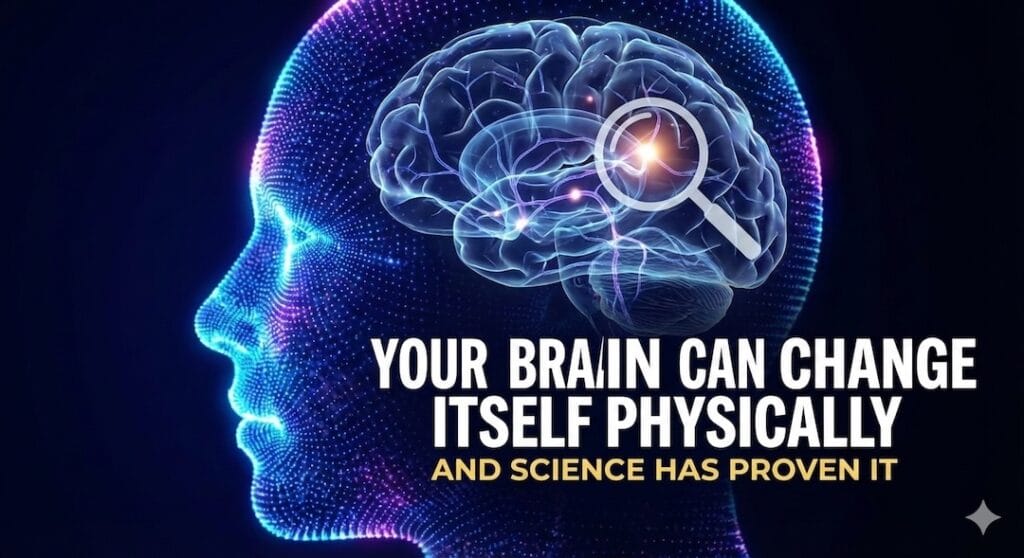
Modern science has proven that your brain physically changes itself throughout your entire life. This real, measurable process is called neuroplasticity, and it is one of the most important discoveries about the human mind.
The Brain Is Not Static, It Is Alive
Your brain contains around 86 billion neurons. These neurons communicate through connections called synapses. Every thought you think, every skill you practice, and every memory you form slightly alters these connections.
When you repeat an action or thought:
- Certain neural pathways strengthen
- Others weaken or disappear
- New connections can form
This is not a metaphor. Brain scans show visible structural changes over time.
Your brain is constantly remodeling itself, quietly, without asking permission.
Proof From Brain Scans, Not Motivation Quotes
This is not motivational psychology. This is observed biology.
Studies using MRI scans have shown:
- Musicians have enlarged brain regions related to finger movement and sound processing
- Taxi drivers develop larger areas responsible for spatial navigation
- People learning new languages show increased neural density in language centers
Even short-term learning can change the brain’s structure in weeks, not years.
The brain adapts to what you repeatedly demand from it.
Injury Recovery Changed Everything We Thought We Knew
One of the strongest proofs came from stroke patients.
Doctors noticed something strange:
- Patients sometimes regained lost abilities
- Different brain areas took over damaged functions
- Recovery happened even years after injury
This should not have been possible under the old “fixed brain” theory.
The only explanation was that the brain was rewiring itself, creating alternate routes around damaged regions.
This discovery changed modern neuroscience forever.
Your Habits Physically Shape Your Brain
Here is the part most people do not realize.
Your daily habits are not just behaviors.
They are instructions to your brain.
- Repeated stress strengthens anxiety pathways
- Constant multitasking weakens attention control
- Regular focused practice strengthens learning circuits
- Meditation measurably alters emotional regulation areas
You are not just forming habits.
You are sculpting brain tissue.
Slowly. Relentlessly.
The Brain Also Shrinks What You Do Not Use
Neuroplasticity works both ways.
Connections that are rarely used weaken and eventually disappear. This process is called synaptic pruning.
It is efficient, not cruel.
The brain removes what it considers unnecessary to save energy. This is why unused skills fade and why learning becomes harder when curiosity disappears.
The brain reflects what you choose to engage with.
Age Does Not Stop Brain Change
Another myth science has destroyed is that brain plasticity ends with youth.
While learning may slow with age:
- Brain change never fully stops
- New neurons still form in certain regions
- Mental training remains effective even in old age
The brain remains adaptable as long as it is challenged.
The limit is not age.
It is stimulation.
A Quiet, Powerful Reality
You are not stuck with the brain you were born with.
Every book you read, every skill you practice, every thought pattern you repeat leaves a physical trace behind. You are not just thinking differently.
You are becoming different, at a biological level.
Your brain is not a finished product.
It is a process.
And it is happening right now.
🔬 Scientific References
The facts discussed in this article are supported by well-established neuroscience research:
- National Institute of Mental Health (Neuroplasticity overview):
https://www.nimh.nih.gov/health/topics/brain-basics - Harvard Medical School – Neuroplasticity explained:
https://hms.harvard.edu/news/brain-plasticity - National Library of Medicine (PubMed) – Brain rewiring studies:
https://pubmed.ncbi.nlm.nih.gov/?term=neuroplasticity - London taxi driver brain study (spatial memory research):
https://www.pnas.org/doi/10.1073/pnas.070039597 - Stroke recovery and brain reorganization research:
https://www.ncbi.nlm.nih.gov/pmc/articles/PMC3712989/