Everyone sit in front of fan in afternoon of summer and we instantly got relief have you ever think.
Let me explain real true in simple plain words:
Fans never cool our room.
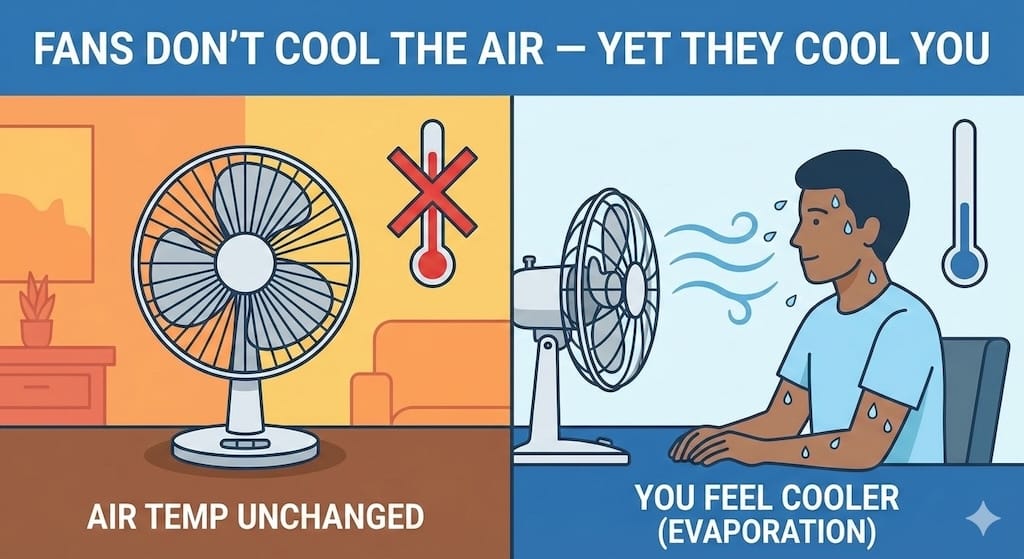
Fan don’t lower air temperature.
Neither they create cold.
And still our body feel relief any way.
There is a very interesting fact of how a fan actually work and if you know that then you will never feel airflow again in same way.
Illusion of Cold Air
Lets put a thermometer in front of a fan.
And turn it on.
Then wait.
You will notice a barely movement in temperature.
Fans are not producing any cold air they are just moving that warm air faster.
So how we can feel like relief?
Because our body does not measure temperature as instrument does.
Our body just measures heat loss.
And fans are so much experts in helping heat to escape.
Our Body Is a Heat Engine
Our body is constantly produceing heat.
Even while we are sitting still:
- Our cells are burning fuel
- Muscles are maintaining tension
- Organs are running chemical reactions
So whatever our body is doing to keep us alive is producing heat so that heat must escape from our body otherwise our body internal temperature will rise too much dangerously.
We loose heat in four main ways:
- Radiation
- Conduction
- Convection
- Evaporation
Fans mainly just hijack last two of them.
Convection: Dragging Heat Away
There is thin layer of warm air clings around our skin.
Which act like a soft blanket for slowing heat losses.
And fan destroys this blanket
By moving air rapidly around our body so fan:
- Sweeps away warmed air
- Replace it with a little cool air
- This maintain a temperature gradient around us
This process is called forced convection.
Heat from our body moves faster in moving air then in still air.
There is no cooling created.
Just heat is escaped faster.
Evaporation: Real Secret Weapon
This is when fans become really powerful.
Our kin always damp even if we don’t feel sweaty.
This moisture comes from sweat glands which are quietly doing their job silently.
So when sweat from our skin evaporates it steals heat from your body.
This heat is called latent heat of vaporization.
Evaporation is incredibly efficient at cooling and a fan help in:
- Increasing evaporation rate
- Preventing humid air from lingering near skin
- Making each drop of sweat to work hard
This is sudden cool sensation?
This is how our body looses heat rapidly.
Why Fans Fail in High Humidity
You also have sometimes noticed that fans actually feel useless on extremely humid days?
This is not your imagination.
When air is already saturated with water vapor then:
- Sweat evaporates slowly
- Heat removal drops
- Cooling effect collapses
Fan is still moving air but evaporation has hit a wall.
This is why:
- Dry heat feels tolerable with a fan
- And Humid heat feels oppressive no matter how fast the fan spins
in both conditions fan didn’t change.
air did.
Why Fans Can Be Dangerous in Extreme Heat
There is a limit for this trick.
If air temperature rises above body temperature then a fan can actually:
- Push heat into our body
- Increase dehydration
- Accelerate heat exhaustion
At these conditions convection happened in reverses direction.
Now we are no longer cooling air.
But air is warming our body.
This is the reason why health guidelines warn us against using fans alone during extreme heat waves.
Why Fans Don’t Cool Empty Rooms
Lets run a simple experiment turn a fan on in an empty room.
And leave it running.
You will find room does not become cooler. In fact it become slightly warmer.
Why?
Just Because:
- Fan motor also generates heat
- Electrical energy becomes waste heat
- No body is present to lose heat
Fans are personal cooling devices not environmental cooler.
Fans only cool people not spaces.
Ceiling Fans and Direction Matter
Ceiling fans have another layer of this trick.
In summer:
- Fans spin in counterclockwise
- Air is pushed downward
- Cooling increases via airflow
In winter:
- Fans spin clockwise
- Warm air near ceiling start circulating downward
- No cooling effect is intended
Same fan.
Same air.
But different heat behaviors.
Direction controls how heat is redistributed not removed.
Psychology of Airflow
There is also a mental component quietly affecting which are.
Moving air:
- Signals freshness
- Reduces stuffiness
- Increases alertness
Our Your brain interprets airflow as relief even before real cooling happens.
This is why even mildly warm air can feel us pleasant when moving.
This sensation of comfort is a part of physics perception.
Fans vs Air Conditioners
Fans and AC part have difference in following ways.
An air conditioner:
- Removes heat from room
- Transfers it outside
- Lowers air temperature
A fan:
- Redistributes air
- Accelerate heat losses from skin
- Leaves room temperature unchanged
Fans are more efficient because they work with our body’s cooling system rather than replacing it.
That’s why fans use dramatically less energy.
Why Your Skin Feels Cold After Fan Stops
Turn off fan and you suddenly feel room is hotter than before.
So what changed?
Our skin temperature is dropped due to evaporation and convection
Once airflow stops:
- Heat loss slows
- Warm air clings again
- Contrast becomes noticeable
The fan didn’t make the room cooler.
It made you cooler temporarily.
A Small Experiment You Can Try
Wet your hand lightly.
And hold it in still air.
Then place it in front of a fan.
You will feel temperature difference dramatic.
This sensation is evaporation in action.
Dry skin cools slowly.
But Moist skin cools fast.
Hidden Elegance of a Simple Machine
Fans are often treated as basic devices.
But they are really elegant:
- They exploit human biology
- They rely on fundamental heat laws
- They amplify natural cooling without any brute force
They are not fighting with physics.
They are just cooperating with it.
The Deeper Takeaway
Comfort is not only about temperature.
But it is about how efficiently our body can release heat.
This is why:
- A breeze feels like magical
- Still air feels like suffocating
- And motion matters more than numbers
fans don’t cool air.
They just frees heat from our skin.
And once you understand that every gust of wind feels like little more intentional.