Imagine this: You’re in a hurry to chill some drinks for a party. You fill one ice tray with piping hot tap water and another with cold water straight from the fridge. A few hours later, you check—and the hot water has turned to solid ice first. What? That defies everything you learned in school about heat and freezing.
This mind-bending observation is known as the Mpemba Effect, and it’s one of those rare scientific puzzles that feels like a glitch in the universe. Named after a Tanzanian student who brought it to modern attention, this phenomenon challenges our everyday intuition about how the world works. In this article, we’ll unpack the history, the science, the debates, and even how you can test it yourself. Get ready for a journey into the quirky side of physics that proves science is never boring.
The Common Expectation: Cold Water Should Always Win the Race to Freeze
We all know the basics. Hot water has more thermal energy—its molecules are jiggling around faster. To freeze, that energy has to be removed until the water reaches 0°C (32°F) and then loses its latent heat to form ice crystals. Logically, starting from a lower temperature (cold water) means less heat to extract, so it should freeze first every single time.
This makes perfect sense on paper. If you plot it out, the cooling curve for cold water should hit the freezing point quicker.That is the reason, why we put things in the fridge to cool them down instead of heating them up. So why does reality sometimes flip the script? That’s where things get interesting—and where the Mpemba Effect enters the story.
The Discovery of the Mpemba Effect: A Student’s Curiosity
The effect gets its name from Erasto Mpemba, a Tanzanian schoolboy in the early 1960s. While making ice cream in a cookery class at Magamba Secondary School, Mpemba noticed something odd. The other students carefully cooled their hot milk-sugar mixtures before putting them in the freezer. In a rush, Mpemba skipped that step and put his hot mixture straight in.
To everyone’s surprise—including his skeptical teacher—Mpemba’s ice cream froze faster. His classmates laughed it off, but Mpemba wouldn’t let it go. He experimented with plain water too and saw the same thing. In 1963, he described it to visiting physics professor Denis Osborne, who was intrigued enough to collaborate. Their 1969 paper in Physics Education formally documented the observation: under certain conditions, hot water (around 90–100°C) could start freezing faster than water at room temperature (around 25°C).
But Mpemba wasn’t the first. Ancient thinkers like Aristotle noted similar ideas in the 4th century BC, and figures like Francis Bacon and Descartes mentioned it centuries later. It was largely forgotten or dismissed as folklore until Mpemba’s work revived interest. His story is a great reminder that curiosity and careful observation can challenge “obvious” truths, even from a teenager.
The Science Behind It: Why Hot Water Can Freeze Faster
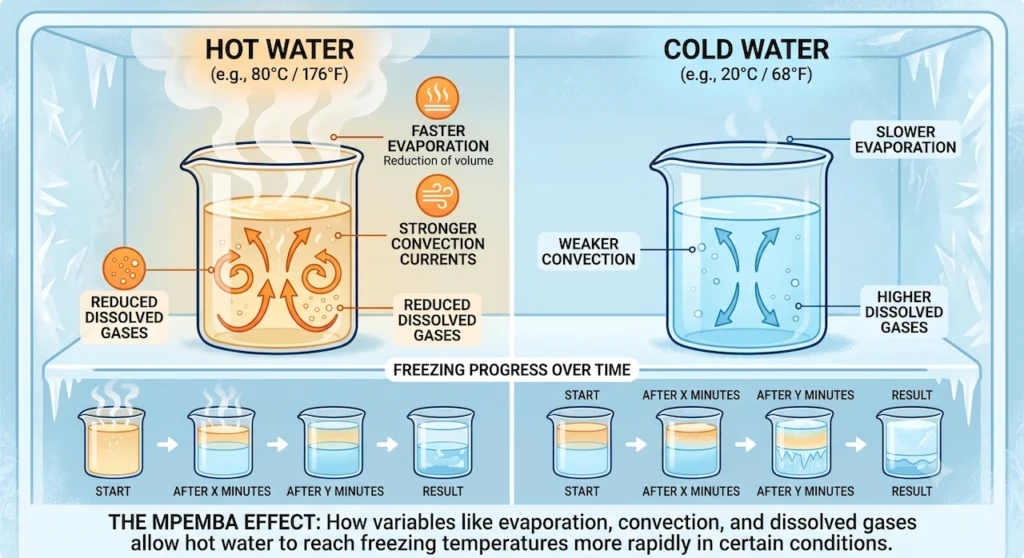
No single mechanism explains the Mpemba Effect perfectly, but several factors often work together. Here’s a breakdown in plain terms:
1. Evaporation: Less Water to Freeze
Hot water evaporates much faster than cold water. As it sits in the freezer or open container, some turns to vapor and escapes. This reduces the volume or mass of liquid left behind. Less water means less stuff to freeze, giving the hot sample a head start. Experiments show this can account for a noticeable difference, especially in uncovered containers.
Think of it like packing for a trip: the hot water “unpacks” some of its load (via evaporation) before the journey to freezing really begins.
2. Convection Currents: Mixing It Up
In hot water, temperature differences create strong convection currents—warmer water rises, cooler water sinks, constantly circulating. This mixes the liquid efficiently, helping heat escape faster from the surface and sides.
Cold water has weaker currents, so cooling is slower and more uneven. The hot water’s internal “stirring” can make the whole volume lose heat more effectively.
3. Dissolved Gases: Clearing Out the Bubbles
Cold water holds more dissolved gases (like oxygen and carbon dioxide). These gases can act like little insulators or affect how ice crystals form. When you heat water, many of these gases bubble out. Degassed water (hot water that’s been heated) often freezes more readily because there are fewer impurities disrupting the process.
It’s similar to how carbonated drinks freeze differently—bubbles change everything.
4. Supercooling and Nucleation: The Freeze That Happens Unexpectedly
Water doesn’t always freeze exactly at 0°C. It can supercool below that temperature if there are no good spots (nucleation sites) for ice crystals to start forming. Hot water, with its different history of heating and gas loss, might nucleate and freeze at a higher temperature than supercooled cold water.
James Brownridge’s experiments suggested supercooling plays a big role. In some setups, the cold water stayed liquid longer while the hot one solidified first.
5. Container and Environmental Effects
The type of container matters. Frost might form on the outside of a cold container, insulating it like a blanket. Hot water melts any initial frost, allowing better contact with the cold surface. The shape, material, and placement in the freezer also influence heat loss.
These factors don’t always align perfectly, which is why the effect isn’t universal.
Why Scientists Still Debate the Exact Cause
Despite decades of study, the Mpemba Effect remains controversial. Some rigorous experiments, like those by Henry Burridge and Paul Linden, failed to find a consistent effect when controlling variables tightly. They argued many observations might stem from measurement errors, like thermometer placement, or subtle differences in setups.
Others, including reviews of multiple studies, confirm it happens under specific conditions. The debate highlights how tricky real-world physics can be—small details like water purity, humidity, or even the freezer’s airflow make a huge difference. Physicists are divided on reproducibility, but many agree it’s real in certain scenarios, extending beyond water to other materials.
This ongoing mystery keeps researchers excited. It’s a perfect example of how science progresses through skepticism, better experiments, and open questions.
Real Experiments and Observations
- Mpemba and Osborne (1969): Used beakers in a domestic fridge. Hot samples (near boiling) often started freezing sooner.
- Science Buddies and Home Tests: Many student projects replicate it with mixed but promising results, especially with evaporation allowed.
- Brownridge’s Work: Focused on supercooling in controlled vials, showing hot water freezing first reliably in some cases.
Results vary widely depending on exact conditions, reinforcing that context is king.
When It Happens—and When It Doesn’t
The Mpemba Effect shines in specific situations: small volumes, uncovered containers allowing evaporation, standard tap water (not distilled), and freezers where convection and surface cooling dominate. It often fails with perfectly insulated setups, ultra-pure water, or when measuring average temperature precisely rather than actual freezing.
In short, hot water freezes faster sometimes, under the right (or wrong, depending on your view) conditions. That’s part of what makes it so intriguing.
Can You Try This at Home? A Simple Water Freezing Experiment
Yes! This is a fun water freezing experiment for science enthusiasts or students. Adult supervision recommended for boiling water.
Materials:
- Two identical containers (e.g., small plastic or glass cups)
- Measuring cup
- Hot water (near boiling, ~90–100°C—use kettle or stove safely)
- Cold water (fridge-cold, ~5–20°C)
- Freezer
- Timer or clock
- Optional: Thermometer, notebook for notes
Steps:
- Measure equal volumes (e.g., 100–200 ml) into each container.
- Place one with hot water and one with cold water side-by-side in the freezer (same shelf, no crowding).
- Check every 10–15 minutes. Note when each starts forming ice on the surface or sides, and when fully frozen.
- Repeat several times, varying conditions (e.g., cover one, use different water sources).
- Record results: Which froze first? Any differences in frost or evaporation?
Tips: Use the same freezer spot. Try with boiled-and-cooled water vs. fresh hot. Safety first—don’t burn yourself! Results may vary, but many see the effect. Share your findings online or in a school report.
Interesting Facts and Myths
- Ancient Roots: Aristotle mentioned hot water freezing faster in his writings.
- Ice Cream Bonus: The effect works with mixtures too—hot ice cream base can set quicker.
- Myth Buster: It’s not magic or “memory” in water. Pure physics (and some chemistry) at play. No, your freezer isn’t haunted.
- Strange Physics Facts: Similar “anomalous” cooling happens in other systems, like certain polymers or even quantum-inspired models.
Practical Applications in Science and Engineering
Understanding the science of freezing water has real-world uses. It could improve cryopreservation, food freezing processes, or even climate models involving water and ice. Engineers might optimize cooling systems or study non-equilibrium thermodynamics. In materials science, it inspires research into faster phase changes. While not a daily tool yet, it reminds us that counterintuitive effects can lead to breakthroughs.
FAQ: Common Questions About the Mpemba Effect
1. Is the Mpemba Effect real? Yes, under specific conditions, but it’s not always reproducible and depends on many factors.
2. Why does hot water freeze faster than cold water? Mainly through evaporation reducing volume, stronger convection, loss of dissolved gases, and differences in supercooling.
3. Does this work with any hot vs. cold water? No. It works best with small volumes, tap water, and setups allowing evaporation and good heat transfer.
4. Can I use this to make ice faster at home? Sometimes! Try the experiment section, but don’t expect miracles every time.
5. What about boiling water specifically? Boiling drives off more gases and promotes evaporation, often enhancing the effect.
6. Are there similar effects in other things? Yes—observed in colloids, some solids, and even modeled in abstract systems. The “inverse” Mpemba Effect (cold heating faster) also exists in theory and experiments.
7. Why do scientists disagree? Subtle experimental differences and challenges in controlling all variables make it hard to pin down universally.
Conclusion: Embracing the Mysteries of Science
The Mpemba Effect shows us that even something as simple as water hiding in the freezer can surprise us. Hot water doesn’t always freeze faster than cold water, but when it does, it’s a beautiful reminder of how complex and wonderful our physical world is. From Erasto Mpemba’s classroom observation to modern lab debates, it encourages us to question assumptions, experiment boldly, and stay curious.
The universe is stranger than we think—and that’s exactly why it’s worth understanding.