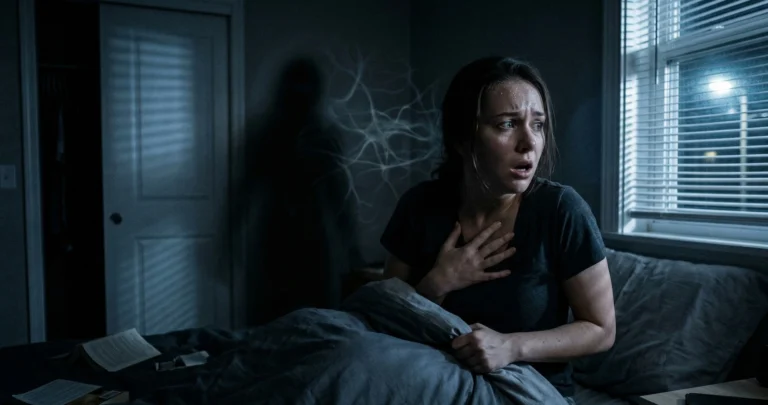
The Night Trap: How Your Phone Quietly Controls Your Mind After Dark
You pick up your phone “just for five minute.”
That’s how it always start, isn’t it? A quick check of your email or reply a text. Sometime just one short video to help you unwind before you finally go to sleep. It feels like nothing serious. It feels harmless.
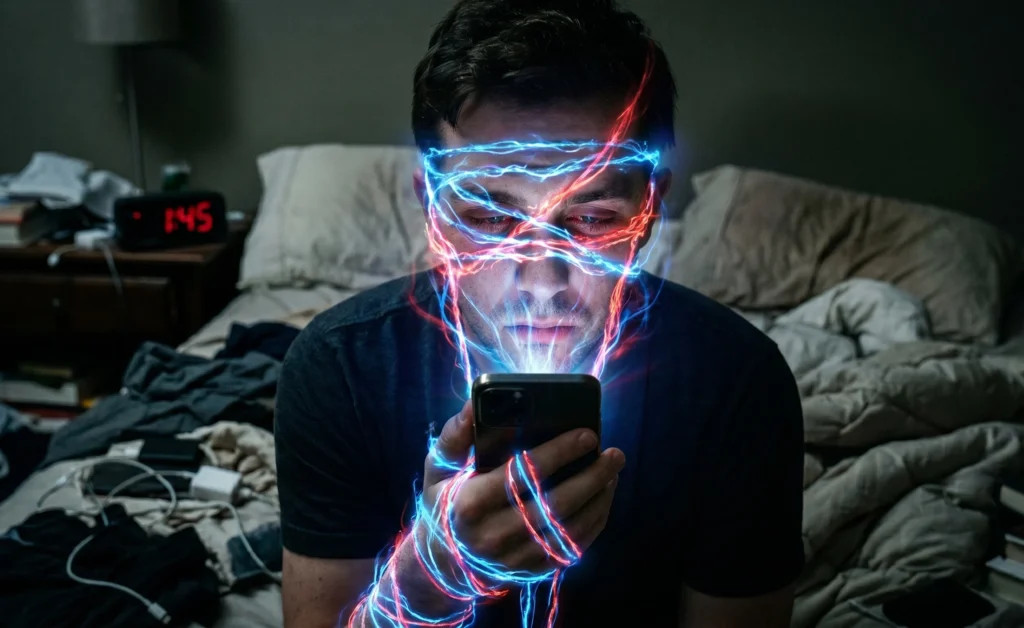
But then, somewhere between one mindless scroll and the next, you lose track of time. You glance at the clock glowing in the corner of your screen.
1:37 AM.
Your eyes burn. Your body feels physically exhausted. Your mind feels dense and heavy. And yet, almost as if it has a mind of its own, your thumb keeps moving, Scroll, Tap, Swipe, Again, Again, Again. You tell yourself, “Just one more minute.” But deep down, you know the truth: it’s never just one more.
If this sounds familiar, you are not alone, and more importantly, you are not weak. What feels like a harmless nightly habit is actually a perfectly designed loop. Here is the reality of what happens to your brain when the lights go out, and how you can finally break free.
This Isn’t Random. This Is a Trap.
It’s very easy to blame a lack of discipline for your late-night scrolling, but that’s a misconception. What you are experiencing is not a failure of your willpower; it is a triumph of engineering, who work hard to design this system which awake you all night.
Your phone is no longer just a tool that you pick up and put down. It has evolved into a fully immersive environment built with one primary objective: to harvest and hold your attention for as long as humanly possible. Features like infinite scrolling, auto-playing videos, and algorithmically timed notifications are not accidents. They are behavioral traps designed by some of the smartest engineers in the world.
Every night, when you are at your most tired and your willpower is completely depleted, you willingly walk into this trap. You think you are winding down, but in reality, your brain is hijacked.
The Quiet Shift You Don’t Notice
At first, your intention is simple and valid: you just want to relax after a long day. But as you stare into the screen, something subtle happens.
Your mind begins to drift. One entertaining video leads to a related one. A message from a friend sparks a completely different train of thought. That thought dredges up a memory, and suddenly that memory triggers a spike of anxiety about tomorrow’s to-do list.
Within minutes, your brain is no longer resting. It is intensely active, chronically overstimulated, and being pulled in ten different emotional directions at once. This is where the real damage begins—not loudly, not suddenly, but quietly.
Your Brain Was Never Meant for This
To understand why this is so destructive, we have to look at biology. Your body follows a natural, 24-hour internal clock known as the circadian rhythm. It is deeply wired, ancient, and incredibly precise.
For hundreds of thousands of years, humans evolved to wind down as the sun set. As darkness falls, your brain prepares for rest by releasing a hormone called melatonin. Melatonin doesn’t just make your eyelids heavy; it acts as a system-wide broadcast to your body, signaling: “It’s safe now. You can shut down. You can recover.”
And during sleep, something extraordinary happens. Your brain doesn’t simply “turn off” like a laptop. It goes to work.
What Really Happens When You Sleep:
- The Deep Clean: Your brain’s glymphatic system activates, flushing out metabolic toxins and waste proteins that have built up during your waking hours.
- Memory Consolidation: It moves information from short-term to long-term storage, strengthening learning and skills.
- Emotional Reset: It processes the emotional load of the day, restoring your psychological balance.
- Physical Repair: It heals tissues, synthesizes muscle, and shores up your immune system.
Sleep is not merely rest. It is active, essential repair. When you interrupt it, even slightly, you are pulling the plug on your body’s maintenance cycle.
The Invisible Manipulator: Blue Light
When you bring a glowing screen into a dark room, you are confusing a biological system that has existed for millennia.
Your phone emits a specific wavelength of light—blue light (roughly 450–480 nm). Your eyes have specific receptors that are incredibly sensitive to this light because, in nature, it only comes from the sun. When you stare at your screen at midnight, your brain gets deeply confused. It receives a false biological signal: “Stay awake. The sun is up.”
Instantly, melatonin production plummets. Your body delays the onset of sleep. And even if you do manage to pass out out of sheer exhaustion, your sleep architecture is compromised. You spend more time in light, broken sleep and miss out on the deep, restorative N3 sleep and the emotionally regulating REM sleep.
Your Mind Stays Awake (Even When Your Body is Exhausted)
Here is the scariest part: Even “Night Mode” doesn’t fix the problem. Lowering your brightness or shifting your screen to a warmer hue reduces the blue light, but it doesn’t solve the underlying issue. Because it’s not just the light keeping you awake—it’s what you are consuming.
Every notification triggers a hit of dopamine. Every message creates anticipation. Every scroll offers a tiny, unpredictable reward. This keeps your brain’s reward centers firing on all cylinders.
Simultaneously:
- Social media triggers comparison and inadequacy.
- News feeds trigger stress and existential dread.
- Late-night texts trigger emotional responses.
Instead of calming down, your brain enters a low-grade “fight-or-flight” state. You think you are unwinding, but you are actually speeding up, diving headfirst into an ocean of noise when what you desperately need is silence.
The Next-Day Hangover and the Long-Term Toll
Poor sleep doesn’t stay confined to the night; it bleeds into your tomorrow.
You wake up feeling groggy, a little slow, a bit more irritable. You might think, “I still got 6 hours, I’m fine.” But over time, the hidden costs accumulate. Your prefrontal cortex—the part of your brain responsible for decision-making, focus, and impulse control—becomes impaired.
The short-term symptoms are subtle but pervasive:
- Slower reaction times and frequent mistakes.
- A persistent, heavy brain fog.
- Reduced creativity and problem-solving skills.
- Emotional fragility and a lack of patience.
When your sleep suffers, your mental health suffers. Screen use at night disrupts serotonin (which regulates mood) and dopamine (which regulates motivation). You get stuck in a vicious loop where you are too tired to engage in healthy habits, so you numb yourself with more screen time, which further destroys your sleep.
The long-term risks are even more alarming. Chronic poor sleep is linked to faster brain aging, severe memory decline, and an increased risk of neurological diseases. Remember those waste proteins your brain clears out at night? When sleep is continually disturbed, those proteins (like amyloid-beta) accumulate, which researchers have heavily linked to conditions like Alzheimer’s and dementia.
One bad night won’t destroy you. But hundreds of bad nights? That’s a completely different story.
The Reconnection Protocol: How to Break Free
Understanding the science is only half the battle. You cannot logic your way out of this trap at 11:30 PM. At night, logic is weak, and habit is strong. You don’t need more motivation; you need a system.
Here are five strict rules to reclaim your nights and your mind.
Rule #1: The Digital Sunset (The 60-Minute Rule)
There should be absolutely no screens 60 minutes before your head hits the pillow. No exceptions. If your goal is to be asleep by 11:00 PM, your phone goes away at 10:00 PM. This sacred hour gives your brain the biological runway it needs to release melatonin, lower your core body temperature, and transition into a state of rest.
Rule #2: Remove the Trigger Entirely
Your phone does not belong on your nightstand. Period. Charge it in your kitchen, your bathroom, or your living room. Buy a simple, $10 digital alarm clock for your bedroom. If your phone is within an arm’s reach when you inevitably wake up at 2:00 AM, you will grab it. Remove the temptation by removing the trigger.
Rule #3: Redesign Your Night Environment
Your brain associates environments with specific behaviors. Right now, your bed is associated with entertainment, stress, and scrolling. You need to retrain your brain to associate your bedroom with one thing: sleep. Keep the room as dark as possible, lower the temperature, and remove unnecessary clutter and lights.
Rule #4: Replace the Habit
You cannot simply delete a bad habit; you have to overwrite it. If you suddenly stop using your phone before bed but leave an empty space, your brain will panic from the lack of stimulation, and you will eventually relapse. Instead, build a calming “wind-down” routine:
- Read a physical, paper book (fiction is best for disconnecting).
- Do a “brain dump”—write down everything you need to do tomorrow on a piece of paper so your mind doesn’t have to hold onto it.
- Practice 10 minutes of light stretching or deep breathing.
Rule #5: The Emergency Protocol
Let’s be realistic: there will be nights where you have to use your phone late (an emergency, an urgent work text). When this happens, mitigate the damage. Turn the brightness all the way down, turn on the blue-light filter, and most importantly, switch your phone’s display to Grayscale mode in your accessibility settings. Removing the bright, stimulating colors instantly makes your phone less appealing to your dopamine receptors.
The Real Choice You Make Every Night
The truth that most people don’t want to admit is that the phone itself is not the problem. The problem is unconscious, automatic use. Once a behavior becomes automatic, it becomes incredibly powerful.
Tonight, you face a choice. It may not feel like a choice, but it is. You are not just choosing between your phone and sleep. You are choosing between control and distraction. Between clarity and noise. Between deep recovery and chronic exhaustion.
When you inevitably reach for your phone tonight, force yourself to pause for just three seconds. Look at the device in your hand and ask yourself:
“Am I choosing this… or is this choosing me?”
Your brain needs darkness. It needs stillness. It needs time offline to rebuild and repair itself for the challenges of tomorrow. The endless feed can wait. The notifications can wait. The world can wait.
But Your mind cannot. Take it back.