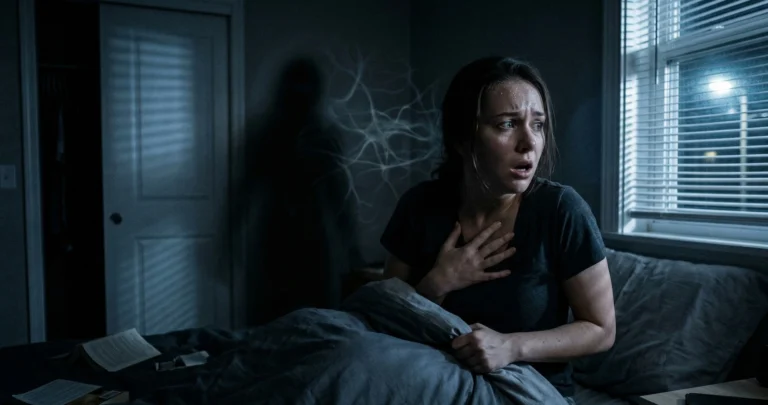
Have you ever woken up from a dream that feel so profoundly real, you needed a few seconds to remember who you are and where are you sleeping?
We usually dismiss those moments as just intense versions of normal dreams—images, voices, and emotions generated by sleeping brain. Science generally explains this phenomenon as a complex neurological process involving memory and perception.
But that profound, lingering confusion between realities makes me wonder, what if, we are looking at these specific dreams from the wrong direction.
What if these hyper-realistic dreams aren’t generated by the brain at all? What if, in those moments, the brain is acting as a translator, trying to interpret something that it cannot be completely understand or new to it?
This is not a established scientific theory. It is a thought experiment about one of the strangest and most disorienting experiences humans can have.
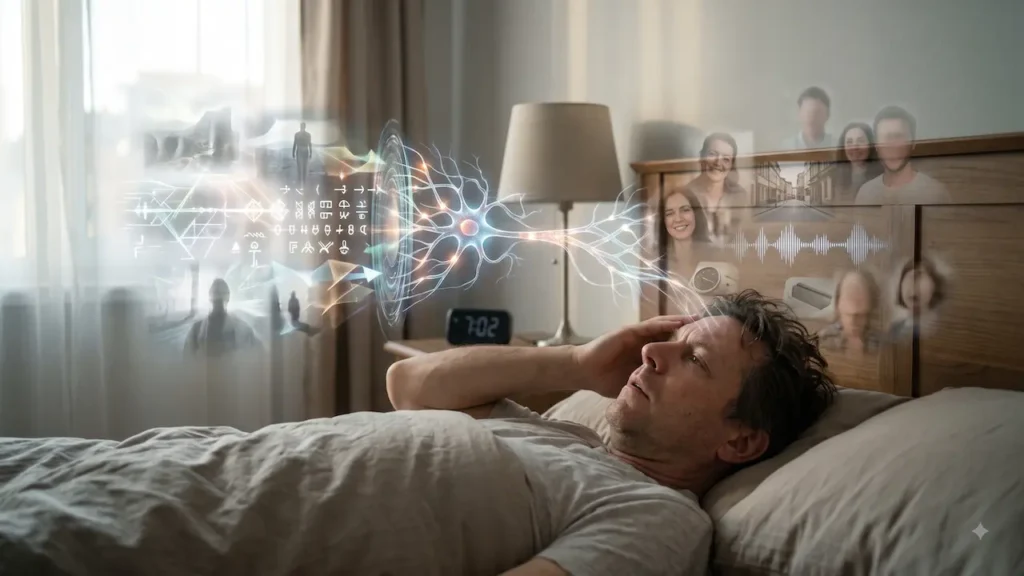
The Strange Moment Between a Dream and Reality
Think about waking from an extremely deep dream. For a few seconds, something unusual can happen.
You don’t immediately know where you are. The dream still feels real. You may look around your room and need a moment to understand: Now “I’m awake. I’m here. It was a dream.”
Normally, we treat this as the brain transitioning from sleep to wakefulness. But what if, there is another interpretation?
What if, during certain dreams, the brain is temporarily operating in a state where it cannot confidently determine which reality it is supposed to be interpreting?
Not every dream would have to work this way. Most dreams could simply be the brain generating stories from memories, emotions, and imagination. But perhaps there is another category of dream—one that feels fundamentally different.
A dream where the problem isn’t the story. The problem is reality itself.
The Problem of the Unfamiliar Person
Here’s where the idea becomes more interesting.
Imagine that you are dreaming about a person. You can see their body. You know they’re a person. You can see their height, movement, clothing, and expressions.
But when you try to look at their face… there is no face. Or perhaps the face keeps changing.
Why?
One possible explanation is that dreams are constructed from information already available to the brain. But let’s take that idea to one step further.
Suppose the brain encounters something in a dream that it cannot identify. It searche its stored memories: “Have I seen this person before?” Nothing matches.
So what does the brain do? Perhaps it tries to find the closest available information. It could take characteristics from several memories and construct an approximation—a familiar face, a familiar voice, a familiar body shape, a familiar expression.
In other words, the brain might not be showing us the original thing. It might be translating it into something we can understand.
What If the Brain Is a Translator?
Imagine seeing something completely unfamiliar. Your brain has no exact memory for it. So instead of displaying an impossible image, it searches through everything it knows.
Maybe the person is approximately the same height as someone you know. Their expression resembles another person. Their voice resembles someone else. Their movements remind you of somebody from your past.
The brain could combine those pieces. And suddenly, the unfamiliar becomes familiar.
You don’t experience: “I don’t know what this is.” You experience: “That’s a person.”
But perhaps it isn’t actually the person your brain shows you. It’s the closest translation your brain can produce.
This could potentially explain why dream characters can sometimes feel strangely familiar even though, after waking, you cannot identify who they actually were.
And what about faceless people? Perhaps the opposite happens when the brain cannot find enough information. There is a person in the dream, but there isn’t enough information to construct a recognizable face. So the face becomes blurred, completely blank, or strangely distorted.
Instead of inventing a precise identity, the brain leaves the missing information unresolved.
Maybe the faceless person isn’t necessarily a person whose face we have forgotten. Maybe the brain never had enough information to translate that face in the first place.
Why Do We Sometimes Remember a Voice but Not a Face?
Consider another strange dream experience. You wake up knowing that someone was there. You remember talking to them. You remember their voice perfectly. But you cannot remember their face.
Why would that happen?
One possibility is simply that memory for different sensory information works differently. But under this hypothesis, there is another possibility.
Perhaps the brain successfully found a recognizable pattern for the voice, but failed to find an adequate visual pattern for the face. So the voice survives the translation. The face doesn’t.
The dream leaves you with: “I know who was speaking.” But you don’t know what they looked like.
The Strange Case of Familiar Faces
Sometimes dream characters did not even look exactly like the people we know. They can look like a mixture of people. A face might feel familiar but look completely wrong. The person may have the eyes of one individual, the expression of another, and the body of someone else.
Perhaps this is simply how memory reconstruction works. But imagine another possibility.
The brain receives something it cannot identify and performs a kind of best-match search. It asks: “What is the closest thing I know?” Then it substitutes that information.
The unknown becomes known. The unfamiliar becomes familiar. The incomprehensible becomes a person with a face.
But Then Comes the Biggest Question
If the brain is only creating dreams from memories… why do some dreams feel like we entered somewhere rather than imagined somewhere?
This is where the idea of an “other dimension” enters the thought experiment.
I’m not necessarily talking about another physical universe with another Earth and another version of ourselves. I’m talking about the possibility that consciousness might enter a state that our waking brain doesn’t know how to interpret.
Perhaps dreams are not always like watching a movie generated inside the brain. Perhaps, in some unusual states, the brain could be more like a receiver, interpreter or translator.
And if it encounters information that doesn’t correspond to anything in memory, it would have to translate it using the closest things it knows.
Why Do We Forget Most Dreams?
This theory could also offer a speculative explanation for something almost everyone experiences.
You wake up from an incredible dream. You remember it. You think: “I’ll never forget this.” Five minutes later… most of it is gone. An hour later… you may remember only one image. A few hours later… nothing.
Science already has explanations for why dream memories can be difficult to retain. But suppose our hypothesis is correct.
Imagine that a dream contains information that doesn’t correspond neatly to anything stored in our waking memory. The brain attempts to translate it. It creates approximations. It substitutes familiar images.
And when we wake up, perhaps the brain retains only the parts that it can successfully connect to existing memories. The rest becomes difficult to reconstruct—not necessarily because the dream was meaningless, but because our brain doesn’t have the vocabulary to remember it.
And This Creates an Even Stranger Possibility
Maybe we don’t forget dreams because there was nothing important to remember. Maybe we forget them because we don’t have the correct memories with which to reconstruct them.
Think about trying to describe a color that humans have never seen. You could use familiar colors as comparisons. You could say: “It’s something between blue and green.” But that wouldn’t necessarily describe the actual color. You would only be translating it into concepts you already understand.
Perhaps dreams could work similarly. The brain may experience something outside its familiar vocabulary. And when we wake up, it tries to convert that experience into memories, images, people, and places. Whatever cannot be converted… disappears from our accessible memory.
What About People Who Cannot See?
This raises another fascinating question. People who have never had visual experience don’t experience dreams in exactly the same way as sighted people. Their dreams can involve other senses—such as sound, touch, movement, smell, and emotion.
That makes intuitive sense if dreams are constructed using information available to the brain. But it also fits an interesting prediction of this hypothesis.
If the brain can only translate an experience using the sensory information it possesses, then someone without visual memories wouldn’t necessarily need to convert an unfamiliar dream experience into a visual face. Their brain might translate it primarily through sound, touch, spatial awareness, or other available senses.
This doesn’t prove the theory. But it gives us an interesting question: If the brain is a translator, does the language it uses depend on what the brain has learned during life?
The Uncomfortable Question
There is a problem with this theory. If dreams are genuinely coming from another source or dimension, how could we test it?
That is where speculation must stop and science must begin. A scientific theory needs predictions that can be tested.
For example: Can people consistently report information from dreams that they could not have encountered through normal sensory experience? Can dream content contain measurable information that cannot be explained by memory, imagination, expectation, or coincidence? Can researchers identify a reproducible difference between ordinary memory-generated dreams and the unusual dreams that feel like a transition between realities?
Until questions like these can be tested, the “other dimension” explanation remains speculation. And that’s important. Interesting doesn’t automatically mean true.
Maybe We’re Asking the Wrong Question
The traditional question is: “Why does the brain create dreams?”
Perhaps we should also ask: “What if the brain isn’t always creating the experience?”
Maybe it is. Maybe it isn’t.
We don’t currently have evidence that dreams are windows into another dimension. But there is something fascinating about the possibility that the brain could act not only as a creator of experience, but also as an interpreter of information.
If that were ever proven, dreams would become something much stranger than random stories produced during sleep. They would become a question about the relationship between memory, consciousness, perception, and reality itself.
And perhaps the strangest part is this: Every morning, we wake up. Our brain tells us where we are. It tells us who we are. It tells us what is real. And we usually accept it without question.
But how does the brain actually know that we have woken up?
Maybe that’s the question we should investigate next.